
UK Goes to the planets
The period between 2003 and 2006 is one of the busiest times in the history of planetary science. British scientists are preparing for an avalanche of data to be sent back by spacecraft that are exploring the Solar System. Their findings will help us understand the origins of our planet and life on Earth.
Hundreds of organisations in the UK have been involved in planning and building these missions. This website has been put together with the help of the scientists and engineers who carried out the work and are now awaiting the results.
The Mission pages give details of the spacecraft, their scientific goals, available resources, links and information about the UK contribution to the missions.
The Timelines page gives details of mission milestones and events in the UK where you will be able to find out more about the missions.
Space has been known as the final frontier for mankind for thousands of years even though the phrase may not have been coined given the many unknowns that it presents.
From as far back as pre-Christian times many of the planets and objects in the solar system were observed and recorded by people who assigned attributes and traits to the objects they perceived in the sky.
Today we do not have to guess as much about what makes up the solar system given that we have the technology to explore the solar system and its planets in great detail; however the ability to do so has still not answered every question.
Science theorises that the Earth is the result of a solar nebula that collapsed upon the formation of the sun which actually resulted in the formation of the entire solar system.
The solar system that resulted that the earth is found in currently holds eight planets, a few dwarf planets, and two smaller bodies known as the asteroid belt and the Kuiper belt.
The eight planets that make up the solar system are Venus, Mars, Earth, Mercury, Neptune, Uranus, Jupiter, and Saturn. The first four are currently referred to as the inner belt of planets and are made of solid rock while the latter four are known as gas planets and are made up mostly of a mix of hydrogen and helium with a liquid metallic hydrogen core.
Pluto is also considered to be a planet by some although officially in 2006 it was named a dwarf planet and is now not officially recognized as a planet in the solar system due to its erratic orbit and small statute.
Two questions about the solar system that are at the centre of many scientific and theological debates are: is there life outside of earth, and how did the earth form?
Scientifically, the earth is the result of the collapse and formed slowly over time as gases combined to form an atmosphere that was suitable for life. Over time, life itself is thought to have evolved on earth as mammals grew more sophisticated and adapted to their surroundings.
Scientists do not believe that there is life outside of the Earth or at least not within our solar system after careful exploration although they do believe that Mars and Jupiter’s moon Europa may have hosted life forms in the past. Today the only life forms that are present outside of the earth are considered to be microbes which are the most basic bacteria life form that is present.
Despite the lack of evidence that there is life in space, scientists use the information from other planets that may have held life in the past to judge the evolution of the earth and to look for clues about how life may have originally formed on the earth.
Why is the UK going the the Planets ?
The Solar System is a vast database of information. By sending spacecraft to study the planets, moons, comets and asteroids, we can find out about our own planet’s past and future. However, it’s a bit like the Internet - there is so much information, that you need to limit your search to a few key questions:
-
Where did we come from?
-
How did life begin on Earth?
-
Is there life elsewhere in the Solar System?
-
What is the Earth’s future?
-
Where did we come from?
Our Solar System formed 4.6 billion years ago from a vast cloud of gas, dust and ice. Since then, some objects (like the Earth) have altered profoundly due to asteroid impacts and volcanic activity. Other objects, such as comets or the topmost layers of the Sun, remain relatively unchanged.
Comets give us a snapshot of the early Solar System as they still contain the materials from the original nebula. ESA’s Rosetta mission to Comet Churyumov-Gerasimenko will land on the comet’s nucleus and analyse samples in an on-board laboratory. NASA’s Stardust mission has brought samples from the tail of Comet Wild 2 back to Earth for testing.
NASA’s Genesis spacecraft collected particles from the Solar Wind and brought them back to Earth for analysis. The concentrations of different elements and isotopes in samples from Rosetta, Stardust and Genesis will reveal the composition of the early Solar System.
Everything in the Solar System originated from the same gas cloud. However, we know that different planets contain different concentrations of elements. To understand why, we need to discover the mechanisms by which planets formed. Saturn’s rings provide an opportunity to look at these mechanisms on a small scale. Using images taken by the Cassini spacecraft, we can study the motion of the rings and deduce how material behaved around the newborn Sun. Saturn’s magnetic field will also give clues about the planet’s internal structure and formation.
The early Solar System was a violent place with newborn planets colliding, breaking up and reforming. SMART-1’s investigation of the Moon’s origins will show us our planet’s early history.
- How did life begin on Earth?
The Huygens probe’s mission was to land on Saturn’s moon, Titan, and search for clues to how organic chemicals turned into life. As Huygens plunged through the haze towards Titan’s surface, it measured the chemical and physical properties of the moon’s atmosphere. The probe landed on an icy surface that showed evidence of weathering by monsoon downpours of methane rain.
Data collected by Cassini in orbit and by Huygens during its descent and after landing will help scientists understand the processes shaping Titan’s surface, and (perhaps) find conditions where life could survive.
- Is there life elsewhere in the Solar System?
As far as we know, water is essential for life. Recent missions to Mars have gathered evidence that water once flowed over the Martian surface. ESA’s Mars Express mission is using radio waves to probe beneath the surface to look for liquid water.
All life-forms leave tell-tale chemical signatures. To gather more direct evidence for life on the Red Planet, the Beagle 2 lander was to look for these signatures by digging up samples of Martian soil and analysing them in an on-board laboratory. Although Beagle 2 was lost on landing future European landers, such as ExoMars, may show whether there is or has ever been life on Mars.
NASA’s Mars Reconnaissance Orbiter will identify landing sites for future missions including, perhaps, the first manned mission to Mars.
- What is the Earth’s future?
Our closest planetary neighbours are very different places. Venus has a runaway greenhouse effect and clouds of sulphuric acid. Mars has very little atmosphere at all. Could either of these fates await the Earth? The Venus Express and Mars Express missions are finding out!
Glossary
Isotopes - alternative forms of an element. Isotopes have the same atomic number but different masses
Solar Wind - particles from Sun’s outer layers that have been blasted out into space.
Rosetta
- AGENCY: ESA
- LAUNCH DATE: 2 MARCH 2004
- ASTEROID STEINS ENCOUNTER: 5 SEPTEMBER 2008
- ASTEROID LUTETIA ENCOUNTER: 10 JULY 2010
- COMET ORBIT INSERTION: AUGUST 2014
- DESTINATION: COMET 67P/CHURYUMOV-GERASIMENKO
- PLANNED DURATION: UNTIL 2015
- MAIN MISSION: TO STUDY THE ORIGIN AND COMPOSITION OF COMETS
Rosetta is the first space mission to attempt to land on a comet.
Rosetta will spend two years travelling with Comet Churyumov-Gerasimenko along its orbital path around the Sun. The Rosetta orbiter will map the surface of the nucleus and analyse gases and dust in the comet’s atmosphere. The Rosetta lander will drop down onto the surface to take ground-based measurements and drill samples from below the surface for analysis.
Sightseeing en-route
Rosetta will take 10 years to reach its target, Comet Churyumov-Gerasimenko. During its journey it will undergo gravity-assist manoeuvres and asteroid flybys.
To build up speed, Rosetta will swing by the Earth three times during its journey. In 2007, it will also slingshot round Mars. As Rosetta approaches the Red Planet, it will take pictures and measurements of the Martian surface to find out which minerals are present in the soil.
Rosetta will also study some asteroids as it flies past. Rosetta’s instruments will measure the size, shape and rotational period of the asteroids and look for traces of dust and gas around them.
UK involvement
Scientists and engineers from 17 organisations in the UK have contributed to the Rosetta mission.
The Open University and the Rutherford Appleton Laboratory have developed Ptolemy, a miniature laboratory that will investigate the chemical make-up of Comet Churyumov-Gerasimenko. British scientists are involved in nine other instruments carried by the Rosetta orbiter and lander. For more details, click on the UK involvement map.
Smart-1

- AGENCY: ESA
- LAUNCH DATE: 27 SEPTEMBER 2003
- DESTINATION: THE MOON
- PLANNED DURATION: 2 – 2.5 YEARS
- MAIN MISSION: TO TEST ION-DRIVE TECHNOLOGY AND PRODUCE A GLOBAL GEOCHEMICAL SURVEY OF THE MOON
SMART-1 is the European Space Agency’s first mission to the Moon (https://www.pleine-lune.org). It is testing out new technologies and mapping the geochemistry of the lunar surface.
Launched in September 2003, SMART-1 took a spiral route to the Moon, arriving in November 2004. SMART-1’s instruments are now gathering data about the Moon’s surface, orbit and plasma environment. Data from the mission will answer questions about the Moon’s origin and evolution.
The European Space Agency is using SMART-1 to test advanced technologies needed for future missions. The spacecraft is propelled towards the Moon by an innovative solar electric propulsion system. SMART-1’s instruments have used the latest miniaturisation technologies.
UK involvement
The UK’s contribution to the mission is a miniature sensor called D-CIXS. The instrument will take X-ray images of the Moon and investigate the chemical make-up of the lunar surface. D-CIXS represents a new generation of X-ray sensors that will be used on future missions to other planets. For more details, click on the UK involvement map.
Mars Express
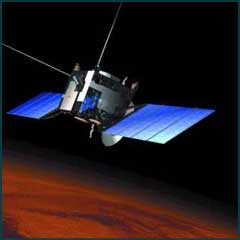
- AGENCY: ESA
- LAUNCH DATE: 02 JUNE 2003
- DESTINATION: MARS
- PLANNED DURATION: 2.5 YEARS (MARS EXPRESS)
- MAIN MISSION: TO INVESTIGATE THE HISTORY OF WATER AND POSSIBILITY OF LIFE ON MARS
Mars Express is the European Space Agency’s first mission to the Red Planet. The spacecraft is investigating the history of water on Mars and mapping the planet in unprecedented detail.
Mars Express orbiter
The orbiter is making a detailed investigation of the Martian surface and atmosphere. Instruments are monitoring gas concentrations in the atmosphere and the processes that drive Martian dust storms. Mars Express will map the entire Martian surface, producing full colour, 3-dimensional images. Mars Express is also finding out what happened to the water that once flowed across the Martian surface. It is measuring how much water has been lost to interplanetary space and using Radar to look beneath the surface for underground lakes and ice.
Beagle 2
Beagle 2 was designed to look for the chemical signatures of life in Martian soil and investigate the atmospheric conditions and geology of the landing site. Beagle 2 was unfortunately lost on landing. However, its ground-breaking miniaturisation technology will be used on future missions.
UK Involvement
UK scientists are involved in three of the instruments carried by the Mars Express orbiter. Beagle 2 was designed and built primarily in the UK. For more details, click on the UK involvement map.
Cassini / Huygens
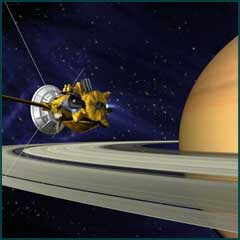
CASSINI
- AGENCY: NASA
- LAUNCH DATE: 15 OCTOBER 1997
- ARRIVAL AT SATURN: 01 JULY 2004
- DESTINATION: SATURN
- PLANNED DURATION: UNTIL JULY 2008
- MAIN MISSION: TO STUDY SATURN, ITS RINGS, MOONS AND PLASMA ENVIRONMENT
HUYGENS
- AGENCY: ESA
- LAUNCH DATE: 15 OCTOBER 1997
- DESTINATION: TITAN
- LANDING DATE: 14 JANUARY 2005
- MAIN MISSION: TO STUDY TITAN’S ATMOSPHERE
Cassini Huygens is an international collaboration to study Saturn and its largest moon, Titan.
Cassini
In 2004, NASA’s Cassini spacecraft began its four-year investigation of Saturn, its rings, moons and magnetic field. Cassini is the first spacecraft to make a long-term study of the Saturnian system. Since arrival, Cassini has made many discoveries, including:
- four new moons, a new ring and various new clumps and structures in Saturn’s F-ring
- an equatorial ridge around Saturn’s moon Iapetus, around 13 km high in some places (taller than Everest)
- the E ring acts as a source of plasma for the magnetosphere
- winds in Saturn’s atmosphere decrease rapidly with height
- Enceladus vents water vapour and ice crystals from cracks at its south pole.
For details of Cassini’s upcoming encounters with Saturn’s moons, see the Timeline.
Huygens
On 14th January 2005, ESA’s Huygens probe descended through Titan’s thick orange atmosphere to reveal, for the first time, the surface of Saturn’s most mysterious moon. The probe, which transmitted data during its descent and for 72 minutes on the surface, showed that Titan has a varied surface with hills, drainage channels and shorelines. As it descended, Huygens found that Titan’s atmosphere was more turbulent than expected.
Huygens landed on a plain of ice “gravel”, with polished ice boulders strewn across the surface. Titan’s surface shows familiar processes of weathering and erosion occurring with unfamiliar materials: ice instead of rock and liquid methane instead of water.
UK Involvement
Imperial College London leads the team behind Cassini’s MAG instrument, which is monitoring the speed and direction of Saturn’s magnetic field. British scientists are also involved in Cassini’s cameras and experiments to monitor Saturn’s atmosphere, plasma environment and dust in the Saturnian system.
The Open University has led development of the Surface Science Package, the first instrument aboard Huygens that hit Titan’s surface. For more details, click on the UK involvement map.
Venus Express
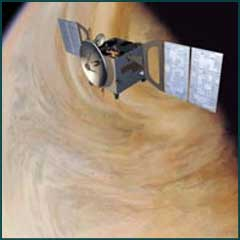
- AGENCY: ESA
- LAUNCH DATE: 9 NOVEMBER 2005
- DESTINATION: VENUS
- DURATION: 2 YEARS
- MAIN MISSION: TO STUDY THE ATMOSPHERE, SURFACE AND PLASMA ENVIRONMENT OF VENUS
Venus Express is the first spacecraft to visit Venus in over 10 years.
The spacecraft is carrying many of the same instruments as Rosetta and Mars Express. Venus Express will follow an eccentric orbit, so that it can take global measurements from a distance as well as detailed close-ups. Instruments carried by the spacecraft will study the Venusian atmosphere and find out what drives the planet’s high-speed winds.
UK Involvement
UK scientists have participated in planning the mission and there is British involvement in four of the instruments. Rutherford Appleton Laboratory is responsible for co-ordinating science operations. For more details, click on the UK involvement map.
Genesis
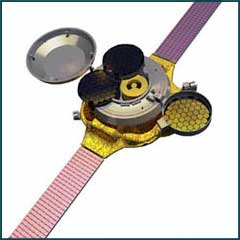
- AGENCY: NASA
- LAUNCH DATE: 08 AUGUST 2001
- DESTINATION: 1st LAGRANGIAN POINT
- RETURN TO EARTH: 08 SEPTEMBER 2004
- MAIN MISSION: TO COLLECT SAMPLES OF THE SOLAR WIND AND RETURN THEM TO EARTH.
Genesis is the first mission to bring a piece of the Sun to Earth.
The NASA mission spent two years bathing in the Solar Wind, a stream of particles emitted by the Sun. Particles from the Solar Wind became embedded in the spacecraft’s collector arrays, which consist of wafers made from materials such as silicon and diamond.
In September 2004, Genesis returned to Earth - a little ahead of schedule. The parachutes that should have slowed the capsule during its descent did not open and the capsule hit the ground travelling at nearly 320 kilometres per hour. Despite this, the project team has managed to recover some samples and it believes that most of the science objectives of the mission will still be acheived.
UK Involvement
The Open University was involved in developing the Solar Wind Concentrator instrument. The instrument has been retrieved from the capsule wreckage and three of four target segments are intact. The good condition of the samples means that wafers containing particles of the Solar Wind were delivered as planned to the OU for analysis in 2005.
Stardust
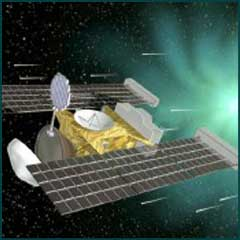
- AGENCY: NASA
- LAUNCH DATE: 07 FEBRUARY 1999
- DESTINATION: COMET WILD-2
- RETURN TO EARTH : 15 JANUARY 2006
- MAIN MISSION: TO COLLECT SAMPLES OF COMETARY AND INTERSTELLAR DUST AND RETURN THEM TO EARTH FOR ANALYSIS
NASA’s Stardust mission has brought samples from a comet’s tail back to Earth for analysis.
Stardust’s deployable collector arrays were fitted with blocks of aerogel, a silicon foam that is 99.8% air. The aerogel slowed down and captured dust particles from the comet’s tail, which were travelling six times faster than a bullet, and samples of interstellar dust.
Stardust flew through the tail of Comet Wild-2 in January 2004. During the encounter, it analysed and collected dust particles from the coma. On 15th January 2006, the sample return capsule parachuted back down to Earth. Scientists are now examining the precious comet samples.
UK involvement
The Open University is involved in Stardust’s Dust Flux Monitor (DFM), which measured the size, distribution and movement of dust particles in the comet’s tail. For more details, click on the UK involvement map
Gallery
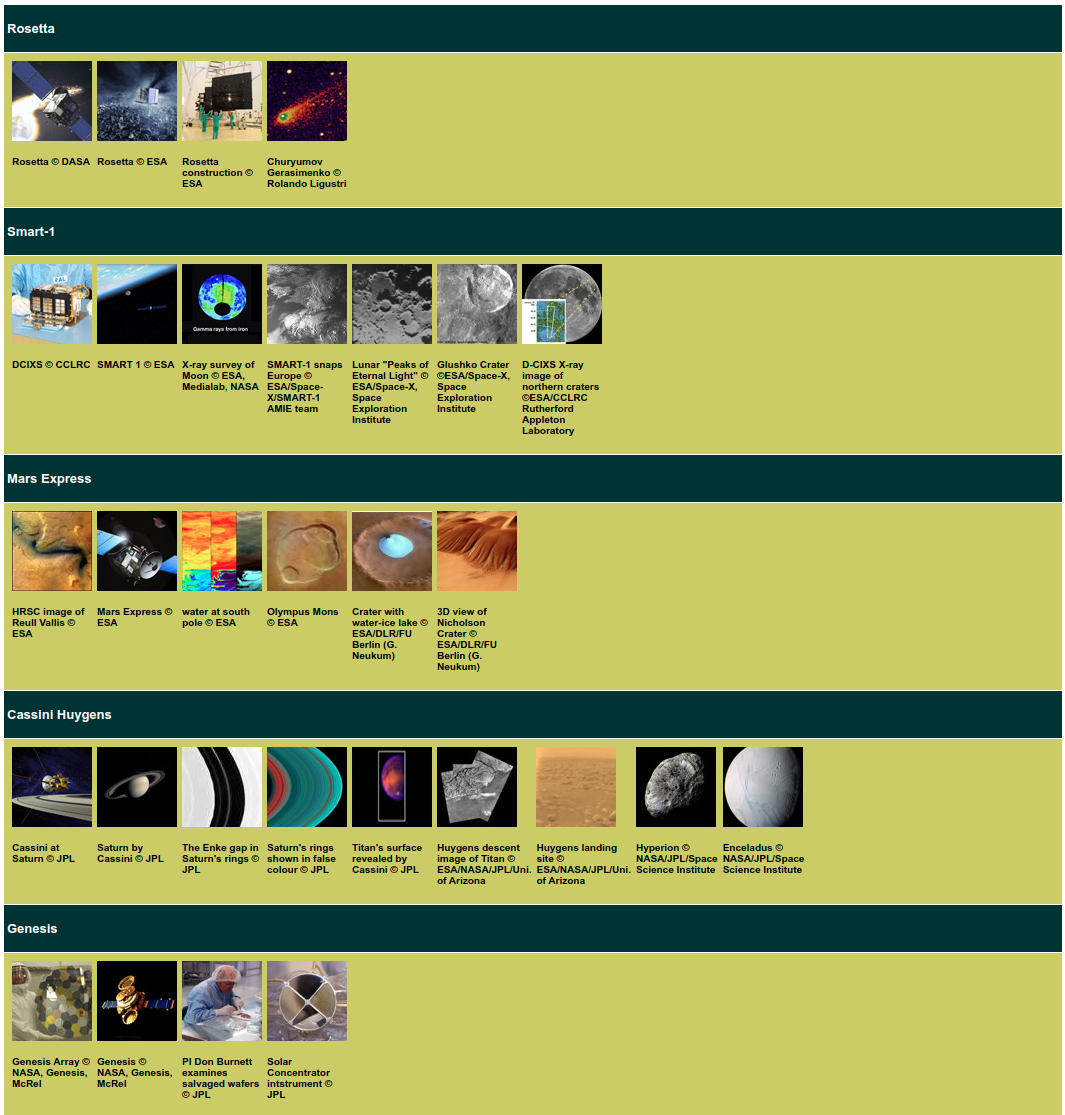
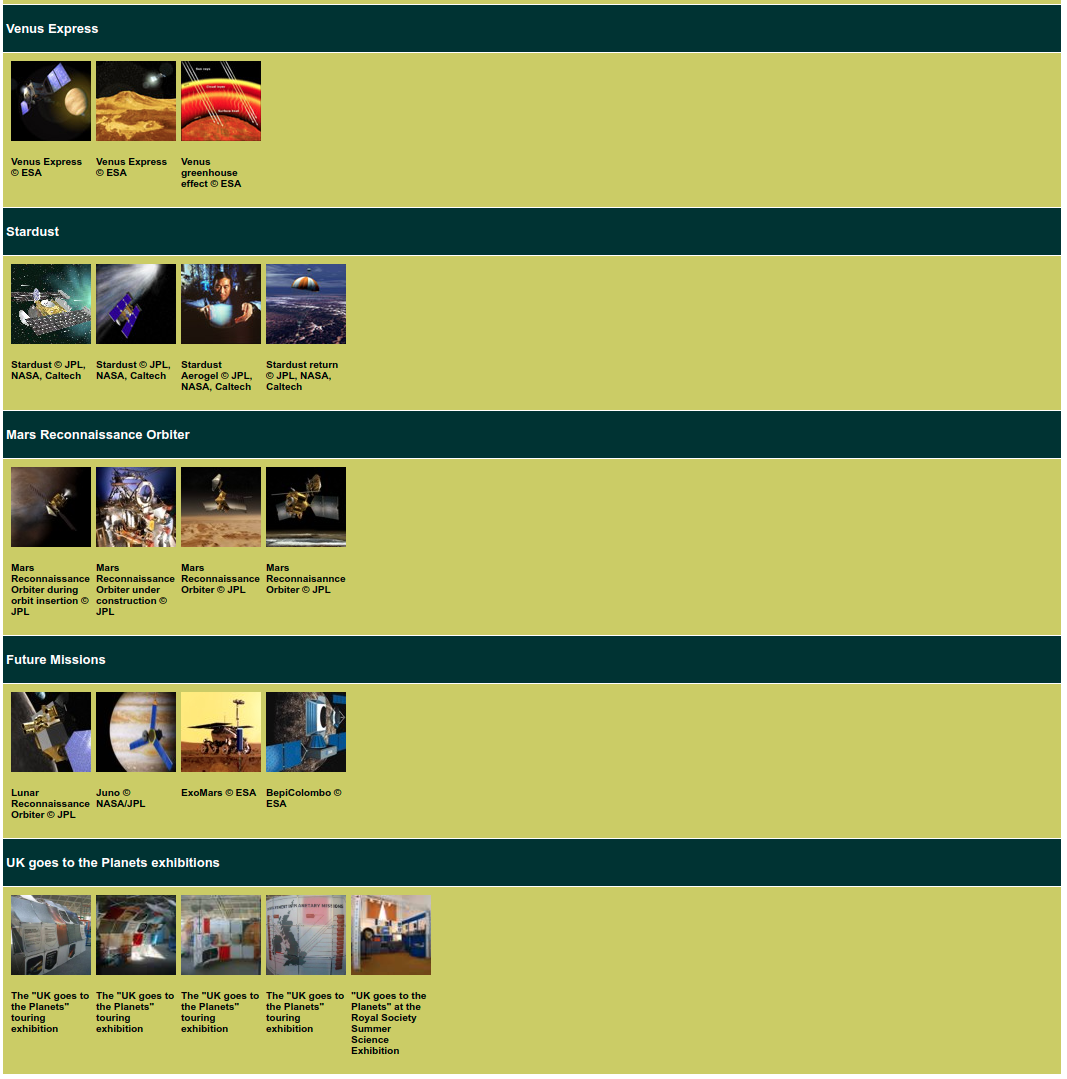
UK goes to the Planets exhibition
UK goes to the Planets, PPARC and the British Council have commissioned a touring exhibition that is now available for booking in 2005.
The exhibition is free of charge to venues and PPARC will cover transport charges. The dwell time at each venue will be approximately two months.
The exhibition consists of two structures: a curving wall and a walk-through tunnel. The entire display covers around 30 square metres. It is light, easy to assemble and can be modified to fit different spaces.
To see full details of the structure, layout and setup, click here: exhibition.pdf and here model.pdf
The exhibition gives an introduction to current projects to explore our Solar System and shows the range of UK organisations involved. The display includes mission factfiles and details of the challenges faced by the scientists and engineers in developing the spacecraft.
To see examples of graphics, click here Intro.pdf, here saturn_comets.pdf and here UKspace.pdf.
Common Questions
We frequently get asked questions about our solar system and the planets. We are gradually adding answers to these questions on the site. Let us know if you have any other questions, and also don’t forget to tell us if you think any of the answers can be improved.
Are there any planets still to be found?
It is quite possible that there are additional planets within our solar system. These would include Ceres which was once an asteroid but now considered by many to be one of the planets of our solar system. There is also Pluto’s moon named Charon, which many astronomers now consider to be a planet in its own right. There is also another object near to Pluto which is about 2500 km across known as Xena, which many now consider to be a planet.
Outside of our solar system many planets have been discovered circling around other suns, and it is reasonably predicted that there may well be an uncountable number of planets in the universe.
Do any planets have any living things?
Tthe short answer is no, but there is a lot of speculation about life forms found within our solar system, most of this theory surrounds Mars as well as to planetary moons known as Titan and Europa.
If life does exist on any of these bodies it will be nothing like a human or any other animal, and will most likely be some form of microscopic life or something simple such as a bacteria. There is continued speculation that Mars was once home to a more earth-like selection of creatures, but there is no evidence for this theory.
Do any planets have water on them?
The short answer is no, but it is possible that some water, in solid form of ice and or frost may be found on several planets including at Mercury’s north pole and possibly at its south pole, there may also be water floating around in the atmosphere of Venus, in a similar form to our clouds.
All of the planets made up of gas such as Saturn and its quite possibly have water in the form of ice in their cores. Some scientists say that there is evidence that Jupiter’s moon Europa may have not only ice but also liquid water.
The Apollo 11 Expedition
President John F Kennedy announced in a speech on May 25, 1961 that America would put a man on the moon before the end of the 1960s. Throughout that decade huge developments in technology were brought about in order to fulfil the promise of the first moon landing.
There were many setbacks and technical problems and even the deaths of astronauts that ultimately led to a level of knowledge to launch Apollo 11 on July 16, 1969. The three crew were Commander Neil Alden Armstrong, Edwin Eugene ‘Buzz’ Aldrin Jr, Lunar Module Pilot and Michael Collins who was the Command Module Pilot.
Four days later on 20th July 1969 they landed on the moon, and on the 21st July 1969 Neil Armstrong became the first man to step foot on our nearest neighbour. He was followed by Aldrin, while Collins stayed in orbit above the moon.
What different elements are the planets made of?
There is not one answer to this question, each of the planets has a different make up, for example, the Earth is made up of about 30% iron, 30% oxygen with many other elements including 14% magnesium. Mercury is also iron in the middle and a large amount of silicate on the surface.
Venus probably also has an iron interior mixed with nickel, but its atmosphere is nearly all deadly Carbon Dioxide. Again Mars is mostly iron with a silicate surface but also about 15% sulphur. Jupiter is mostly made up of gas, 10% Helium and 90% Hydrogen. Saturn is very similar in its makeup.
Uranus is mostly ice made up of methane, ammonia and water. Neptune is rock with about 15% the same ice as Uranus. No one knows exactly what Pluto is made up of.
What is a space rocket made of?
NASA’s Space Shuttle has a huge external fuel tank which is the dark orange part; this is the main fuel supply to push the shuttle out of Earth’s orbit. The Solid Rocket Boosters are the two white rockets seen on either side of the shuttle; these are basically the same as a bonfire night rocket and are intended to give the space shuttle an extra boost on lift-off.
The main part of the shuttle is the Orbiter Vehicle, this is the part that looks basically like a plane and carries the crew and the shuttle’s cargo.
What is the most interesting planet?
From the average person’s point of view Mars, our nearest neighbour is the most interesting planet. For many hundreds of years philosophers, astronomers, scientists and ordinary people have speculated all manner of possibilities for Mars, especially the concept that creatures known as Martians lived on the surface and even carved out canals and a huge sculpture of a human like face surface.
All of this is probably because it is relatively so close to us in distance, and even today because of its neighbour status, it is the main focus of planetary exploration for NASA. This is possibly due to the enduring thought that life may, or may have, existed on the planet and also possibility to one-day we may be able to set up colonies on its surface.
What order do the planets go in?
The Sun is at the centre of our solar system and all the planets orbit around the sun at various distances.
The nearest planet to the sun Mercury, followed by Venus, then Earth Mars, Jupiter, Saturn, Uranus, Neptune, and finally Pluto.
There is a large amount of speculation, and some considerable scientific evidence, that there may be two or more planets further out than Pluto.
Which is the newest planet?
According to the same nebular hypothesis if the big gassy planets further away from the sun are the oldest because it would take them longer to get so big, then the smaller rocky planets nearer the sun would be the youngest.
Therefore, Mercury, followed by Venus, then Earth would be the youngest. However, there are multiple different theories based on different ideas as to which are the youngest and oldest planets.
Which is### the oldest planet?
This is open to debate, but the most commonly accepted calculation is known as the nebular hypothesis.
According to this theory the oldest planet would be the gas planets furthest from the sun, i.e. Uranus, Neptune, and Pluto. They may date back as far as 5 billion years, although it is considered that there may well have been other older planets, which have since disappeared.
How did the Earth form?
The question of how the earth formed is one that has many scientific and religious answers and is the subject of one of the most controversial debates of all time.
From the scientific viewpoint, the Earth would have had to form about 4.54 billion years since the earliest material in the solar system is dated back to about this time period. It is scientifically accepted that the solar system including the earth was the result of a solar nebula that collapsed from the formation of the sun.
The dust and gas from the solar nebula took about 10-20 million years to form into the earth starting with the molten centre of the Earth which cooled down to form a crust that allowed water to begin to accumulate.
The moon, the main satellite of the Earth is believed to have formed about 4.5 billion years ago when an object that roughly was the size of Mars collided with the Earth causing a significant blow to the Earth. It is theorized that some of the mass became Earth and the remaining chunk begin to orbit the Earth in what is now known as the moon.
The atmosphere of the earth is thought to have formed from volcanic activity and escaping gassing. The oceans on the earth were produced by water vapour from asteroids and other planets that may have collided with the earth. Due to the greenhouse gases that exist in the atmosphere and solar activity around the earth the surface temperature of the earth remains high so that the oceans do not freeze up.
Life on earth is scientifically attributed to evolution. There have been five mass extinctions as defined by scientist with the last extinction destroying dinosaurs and other large reptiles but allowing some mammals to survive. According to the theory of evolution over 65 million years ago mammals begin to adapt to their surroundings until eventually humans were formed.
If Earth follows the same pattern of life that exists in the rest of the solar system in about 900 million years the oxygen on the earth will become too toxic for plants, water will disappear a few billion years later, and the average temperature of the earth will reach 70C.
It is estimated that the Earth can remain host to human life for about 500 million more years a figure that can be extended for an additional 2.3 billion years if nitrogen was removed from the Earth’s atmosphere.
The Planets
Read our guide to the planets in our solar system. Find out what is unique and different about each of the planets by clicking on the appropriate planet link below.
Earth
Earth is the planet that humans call home and is the fifth largest planet in the solar system. It is the third from the sun and the only planet that was not named after Roman or Greek mythology. Earth was not considered to be a planet until the sixteenth century due to the fact that it was not observed from an objective standpoint.
The earth has a fairly complicated atmospheric composition when compared to the other planets and involves several levels. Most of the mass that makes up the Earth is mantle with the rest considered to be the core.
The core of the Earth is mostly made of iron although there are a few lighter elements such as nickel in there as well. At the core temperatures can reach as high as 7500K even though temperatures on the surface never reach that high naturally apart from volcanoes.
One significant difference between the other eight planets and the Earth is that the Earth’s crust is separated into tectonic plates that move and shift. Presently eight plates make up the entire crust of the Earth. Earth is also the only planet where oxygen is rapidly produced and where water exists in a liquid form.
Jupiter
Jupiter is the largest planet in the solar system and is the fifth planet from the sun. In fact, Jupiter is over twice as large as every planet’s mass combined. It is only fitting than that Jupiter was named after Zeus the king of the Gods in mythology. In historic times it was referred to as a wandering star until 1610 when Galileo discovered that it had four moons. Jupiter is a gas planet which means that there is no solid surface on it, and the gases that make up the planet are hydrogen and helium. There are also traces of ammonia, water, and methane in the planet as well.
Although Jupiter’s interior is widely a mystery, it is believed that there is a core of rock inside that is approximately the size of ten earths. Most of the planet’s bulk is made of liquid metallic hydrogen which is what gives the planet its unique colours.
Clouds are believed to surround Jupiter that is made of ice, water, ammonium hydrosulphide, and ammonia ice. Jupiter is well known for is Great Red Spot which can be seen from the earth. Due to the size and mixture of gases that compose the planet, it is able to radiate out more energy than it gets from the sun.
Mars
Most likely Mars got its name due to its bright red colour since the Greek God Mars is the good of war. Due to its colour often you will hear Mars referred to as the Red Planet. Mars has been recognized since prehistoric times but it has been studied for a long time period afterwards as it is the closest planet that could support life next to the Earth. Mars is the seventh largest planet in the solar system, or in other words the third smallest and is the fourth planet from the sun.
Mars travels in an elliptical orbit and as a result has different climate zones throughout the planet much like the Earth. The average temperature on Mars is about -55C, but temperatures can range anywhere between -133C and 27C depending on the season. Mars has one notable mountain on it that rises up 24KM and also has a large valley of canyons on the surface both of which prompted scientists to believe at one time that the land was inhabitable.
Most of the land on Mars is cratered and aged, but there are some valleys, plains, and ridges. There is some evidence of erosion on the planet which suggests that at one time there was a liquid on the planet.
Mercury
Mercury is the eighth largest planet in the solar system and is located nearest to the sun. It has been known of since the 3rd millennium BC when the Sumerians named it as an evening and morning star. Mercury does not have a regular orbit, but instead switches its orbit as it rotates around the sun at a comparably slow rate next to the other planets.
Despite being slow, due to its proximity to the sun the planet rotates around the sun three times in only two years making it the only planet that does not have a ratio of 1 one orbit per year.
Mercury is also known for its eccentricity when it comes to climate with temperatures that range in no consistent pattern. On average temps range from 90K to 700K degrees. Mercury is the densest planet in the solar system excluding Earth with a dense iron core.
Due to this fact, the crust of the planet is made of thin mantle. The surface actually resembles the moons filled with wide craters and solar winds that blow across the planet and out into the atmosphere. It also has a North Pole region where ice water is trapped that has been shown by satellites.
Neptune
Neptune is the fourth largest planet in the solar system and is the eighth planet away from the sun. It was named after the God of the Sea in Roman mythology due to the fact that it appears to have an entirely blue sea like colour. Due to its odd orbit, the planet was not identified as part of the solar system until 1846 although it had been noticed in the past while scientists studied Jupiter. Neptune and Pluto cross each other technically making Neptune the farthest planet from the sun at certain times of the year.
Due to its distance from the earth not as much is known about Neptune as the other planets although its composition is assumed to be close to Uranus’ and made mostly of hydrogen with some helium gases as well.
Its blue colour is from the absorption of methane’s red light but there is also expected to be chromospheres in the atmosphere which strengthens the blue colour. A unique attribute of Neptune is that it has the fastest winds out of all the planets in the solar system with winds that can reach up to 2000km/hr.
Pluto
Pluto has an orbit that passes outside of Neptune and is the debatable ninth planet in the solar system farthest from the sun and smallest in mass. In fact, seven of the planets have moons that are larger than Pluto.
Today Pluto is technically classified as a dwarf planet but many people still consider it to be the ninth planet in the solar system. Due to its distance away from the Earth it is also the only planet that has not yet been reached by a spacecraft for further investigation. Despite its small size, the planet does have two moons that rotate around it.
Pluto has a distinct orbit as it rotates in the opposite direction of all the other planets. It can be closer to the sun at times than Neptune due to its erratic orbit although technically it still falls into place as the farthest planet from the sun. The temperature on Pluto is very cold and ranges between -210C and -235C. Although little is known about the atmosphere of Pluto, scientists guess that it is made of nitrogen and a mix of carbon monoxide and methane.
Saturn
Saturn is the second largest planet in the universe after Jupiter and is the sixth planet away from the sun. The planet has been recognised since ancient times and is most widely known in pop culture for its rings. In fact, every few years in the orbit of Saturn the earth passes through its rings. Saturn is the least dense of all the planets and is made mostly of gases. It is made of helium and hydrogen for the most part although there are also a few traces of methane, ammonia, and water. Its interior core is made of a liquid metallic hydrogen layer that is underneath a hydrogen layer.
The temperature on Saturn is very hot reaching up to 12000K at the core. Though the rings of Saturn look solid from the Earth, they are actually composed of water ice and some rocky particles that have ice encasings.
Most of the rings are 250,000km in diameter but are not more than 1km in width. Saturn has many moons out of which 34 are identified and two of which rotate at the same synchronized rate. The planet is visible with the naked eye at certain times of the year from the Earth but you will need a telescope to see its rings.
Uranus
Uranus is the third largest planet in the solar system and is the seventh planet from the sun. Although the planet has a large diameter it is still has a smaller overall mass than Neptune its neighbouring planet. Uranus was first discovered in 1781 by William Herschel although its full status as a planet and its name was not used until 1850.
One notable fact about Uranus is that it spins on a parallel basis to the ecliptic instead of perpendicular like most of the planets. The change means that the Polar Regions on the planet are actually warmer than other locations on the surface.
Due to the odd rotation, scientists area currently not sure which of the poles in Uranus is actually the North Pole of the planet. It is mostly made of rock and ice sitting so far outside the sun and is only made of a small amount of hydrogen and ice unlike its neighbour Saturn.
Not much is known about the core of Saturn but it is estimated that the planet does not have a rocky core. Uranus has rings around it at as well but they are small and dark thus making it hard to see from the earth.
Venus
Venus is the sixth largest planet in the solar system and is the second planet from the sun. It is found next to the Earth and has been recognized since prehistoric times as the brightest object that is located in the sky next to the sun and moon. Due to its immense brightness Venus was named after the Greek God of love and beauty. It has the most consistent orbit of all the plants and is almost perfectly circular in shape. The rotation of Venus is very slow with one Venus day equal to 243 days on the Earth.
Some scientists refer to Venus as the sister plant to Earth because they share many similar attributes. First of all, Venus is only a little smaller than the earth and both do not have many craters which indicate that they are both fairly new planets in contrast to the other planets.
They also have similar chemical compositions and densities. The similarities end when you get into Venus’ atmosphere which made mainly of carbon dioxide with clouds made of sulphuric acid. Additionally, the temperature on Venus ranges from 400K to over 740K which is hot enough that lead would melt.
The Solar System
What is the solar system?
The solar system is made up of the sun as its primary focus and all of the planets that orbit it due to the pull of its gravity. It is scientifically understood that the solar system was formed when a giant molecular cloud collapsed about 4.6 billion years ago.
There are eight planets that rotate in orbit around the sun making up the solar system: Mercury, Mars, Venus, Earth, Saturn, Neptune, Jupiter, and Uranus. Depending on whom you ask Pluto is also the ninth planet but technically it is now considered a dwarf planet and is thus not one of the major planets or our solar system.
Interestingly enough, scientists theorize that there are an unlimited amount of solar systems that exist throughout the universe, but for purposes of common reference the phrase ‘solar system’ is understood to mean the system the earth is part of.
There are two belts of small bodies that are also housed by the solar system, the Kuiper belt which is composed of ices and the asteroid belt which as it sounds is mostly made of rock and water. The Kuiper belt lies outside of the orbit of Neptune and the asteroid belt lies between Mars and Jupiter.
There are also many small bodies that are contained within the solar system such as centaurs, dust, comets, plasma, and solar winds. Each of these objects fly freely within the solar system and can be isolated or attached to the planets that lie within the solar system.
Six of the planets including the earth have natural satellites or ‘moons’ that rotate and orbit around the planets. The outer planets that are located past Mars are mostly gas planets and have rings made of dust that rotates around them.
It was not until Galileo that the idea of the solar system began to gain acceptance on the Earth as many people thought that the Earth was the centre of the universe and that everything else rotated around it. Since ancient times the invention of satellites and rocket ships have helped scientists gain a better understanding of the solar system.
Like the Earth, most of the planets that are found in the solar system have their own secondary systems with moons, rings, or objects that rotate due to the gravitational pull of the planets.
The solar system is generally split into three categories, planets, dwarf planets, and smaller solar system bodies such as asteroids.
The sun is the brightest star in the Solar System and is able to heat not only Earth but many of the other planets as well until you reach to the far distant planets.
The end of the solar system is not officially defined, although it is understood that the end of the solar system is found when the suns gravitational pull stops. This area is estimated to be about two light years away from the sun. It also can be classified as the area where solar winds stop.
Is there life elsewhere in the Solar System
For many years the question of is there life outside of the earth in the solar system has fascinated authors, scientists and people in general who wonder if people are alone in the universe. Although the answer is not certain given that we are unable to travel deep into the universe it is commonly scientifically understood that life in its advanced human form does not exist outside of the Earth.
However, one thing that scientists have been able to ascertain for certain is what areas in the solar system could support life or may have supported life in the past even if there are no longer life forms present.
Current scientific knowledge states that there is not life outside of the Earth that is intelligent, but there may be some bacteria life or microbe life outside of the earth. This is the simplest form of life there is, and is the most complicated form of life that is expected to be found outside of the solar system.
The two locations in the solar system that possibly could support life or may have supported life in the past are Jupiter’s moon Europa and Mars which was speculated to have life forms for years before scientists were able to reach the Red Planet and prove otherwise.
Intensive study of Mars scientists theorise would show that there are microbes on the planet, but Europa is the location where more developed life forms may be present if they are found anywhere within the solar system.
Despite the fact that these are the only two objects in the solar system that suggest they could support life today, there are still other objects in the solar system that may help explain the evolution of life in the solar system.
For example, Titan, a moon of Saturn, could possibly explain some of the chemistry mysteries of life and on of Jupiter’s moons, Callisto, has been recently surveyed for clues about the existence of life in outer space as well.
Therefore, while no one can ascertain for sure that there is life in outer space the commonly accepted answer is no although evidence on several bodies in space suggest that at one point in time life may have existed on other planets.
Mars – the Search for Martians
The planet Mars has been named by many of Earth’s civilizations, including Babylonians, Greeks, Romans, Egyptians and many others, and almost always it has been named after a god of war or fire. This is due to what is now known to be iron oxide, (what most of us know as rust) which gives the planet its reddish color. The “Red Planet” has fired the imagination of generations, both the scientists and the dreamers.
Those of us who grew up with Ray Bradbury and Robert Heinlein had good reason to suppose that intelligent Martians might very well exist. H. G. Wells’ The War of the Worlds, about Martians invading Earth because their planet was dying, caused a serious panic when it was broadcast as radio news in 1938.
However, there were no Martians, and based on the latest exploration by satellite probes and land rovers on Mars’ surface, there never have been – or could be. The “fiery” red planet has been observed and photographed ‘close up’ and actual samples have been taken in various sites on the surface and in the atmosphere.
Mars appears to be lifeless and covered with dust, which swirls in the solar winds to form dust storms that make the Dust Bowl in the 1930’s seem like a polite sneeze. The atmosphere is so thin that water cannot retain its liquid form. However, the latest findings indicate that at some time long ago the atmosphere was denser and surface water probably existed.
The ‘canals’ that some speculated to be a means of irrigation by intelligent beings turned out to be channels, gullies and canyons, which most scientists believe were formed by water. Great quantities of water ice have also been discovered beneath the surface of Mars, and caves of unknown depth that may, as some believe and many hope, may yet harbor some form of life.
Near Miss Asteroids – Example of 2012DA14
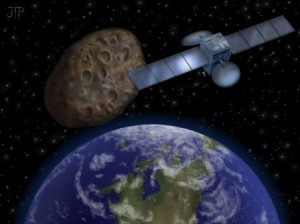
Artist’s impression shows how the ‘near-miss’ asteroid might look passing in-between Earth and its communication satellites on Friday 15 February. (Copyright: The University of Hertfordshire)
An asteroid the size of a small office block is due to pass by Earth on Friday 15 February 2013 in one of the closest ‘near-misses’ in recent history. Although there is no chance of the asteroid hitting Earth, the huge rock is being closely monitored by astronomers at the University of Hertfordshire’s Bayfordbury Observatory, as part of an on-going programme to monitor ‘Near Earth Objects’ (NEO).
Weighing 130,000 tonnes and travelling at over 28,000 miles per hour, the asteroid, officially named 2012DA14, will pass in-between Earth and its communication satellites such as Sky’s Astra satellite. Astronomers Dr Mark Gallaway and David Campbell are using high-powered telescopes to track its movements.
Mark said: “Although there is absolutely no chance of this particular asteroid hitting Earth, it does highlight the dangers of so called ‘Near Earth Objects’ of which about ten thousand of the expected one million have been identified. By monitoring its movements we will be able to improve our understanding of these potentially hazardous objects.”
Too faint to see with the naked eye, the asteroid, which will pass closest to Australia, will be visible through binoculars.
For more information on the research undertaken by Bayfordbury Observatory, visit http://bayfordbury.herts.ac.uk/research-at-bayfordbury-observatory.htm
Picture caption 1: Artist’s impression shows how the ‘near-miss’ asteroid might look passing in-between Earth and its communication satellites on Friday 15 February. (Copyright: The University of Hertfordshire)
To find out more about this site and available resources, please contact:
Anita Heward, UK goes to the Planets Co-ordinator, Braemar House, Braemar Close, Godalming, Surrey GU7 1SA
Tel: (01483) 420904 | email: anitaheward@btinternet.com
Consortium members include Armagh Observatory, BNSC, EADS Astrium, Imperial College, the University of Leicester, Mullard Space Science Laboratory, the National Space Centre, the Open University, the University of Oxford, the Particle Physics and Astronomy Research Council (PPARC), Queen Mary University of London, the Royal Astronomical Society, Rutherford Appleton Laboratory, UCL, the UK Planetary Forum and the UK Planetary Robotics Network.